What the Future of SEO Actually Looks Like in 2026
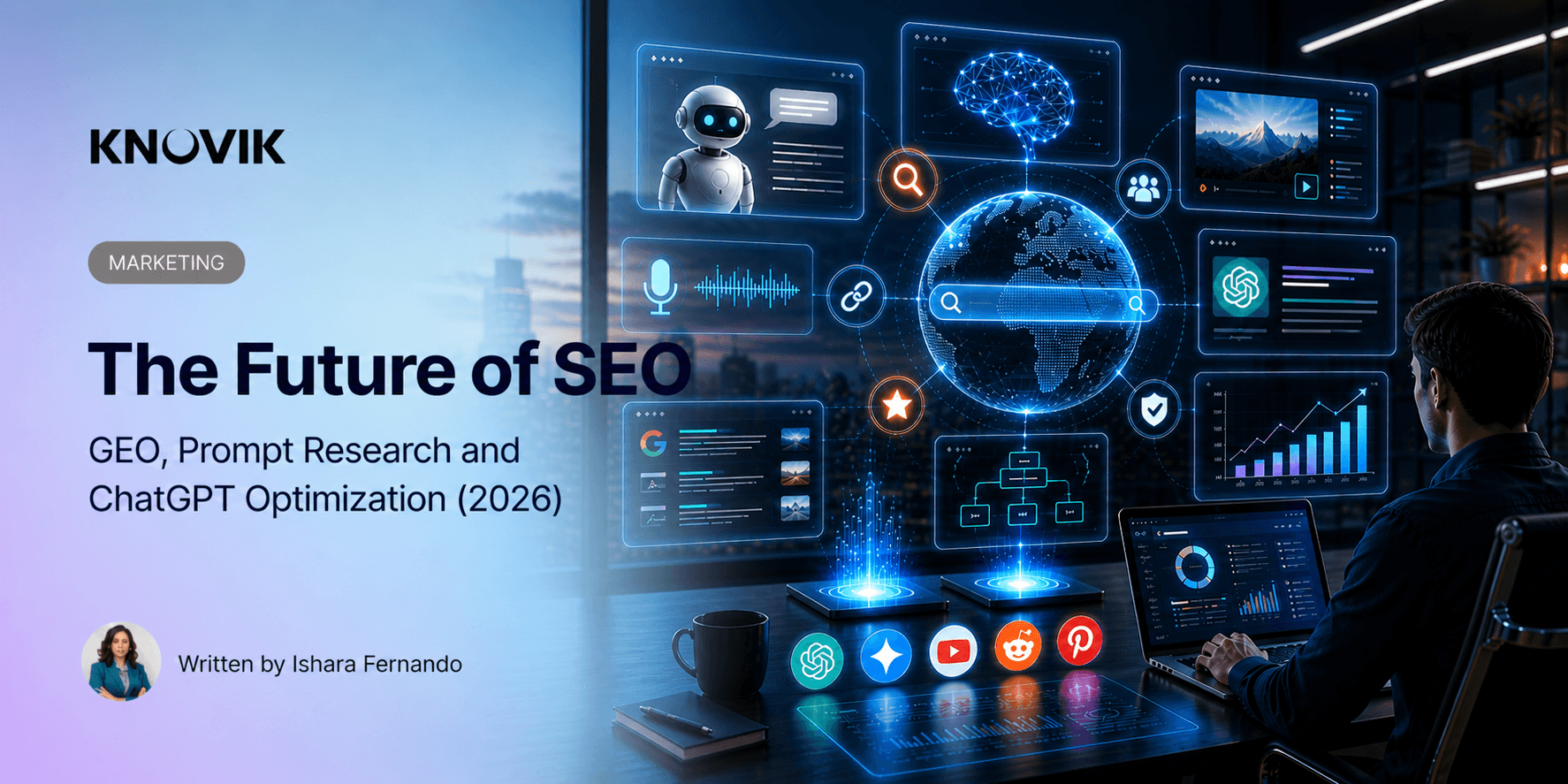
Search has quietly changed shape. The top of a Google results page now often leads with a generated answer, not a list of links. ChatGPT users are asking full questions and expecting complete responses. Perplexity cites sources inline. The behavior that SEO was built around, a user typing a keyword and clicking a blue link, is no longer the dominant pattern.
One of the biggest changes in how teams should think about this is the rise of prompt research: the process of studying the full questions people ask AI systems, not just the short keywords they type into search engines. Understanding what replaces traditional search behavior is not optional anymore. It is the whole game.
The future of SEO is about being cited by AI systems, not just ranked by algorithms. This shift is called Generative Engine Optimization (GEO). It requires content that is structured for extraction, supported by evidence, and written at a level of specificity that AI platforms can confidently quote. Traditional keyword strategy still applies but now forms the floor, not the ceiling.
What Is Generative Engine Optimization and Why Does It Matter?
Generative Engine Optimization is the practice of making content discoverable and citable by AI-powered search platforms including Google AI Overviews, ChatGPT, Perplexity, and Gemini.
The difference from traditional SEO is structural. Traditional SEO gets a page ranked. GEO gets a passage cited. These are not the same thing, and they do not always correlate.
A page ranking seventh for a competitive query can still appear as a cited source inside a ChatGPT response if the content is well-structured and factually specific. Conversely, a page ranking third can be completely absent from AI-generated answers if the content is too vague, too general, or too difficult to extract a clean answer from.
According to Advanced Web Ranking data, Google AI Overviews now appear in over 60% of US searches as of late 2025, up from around 25% in mid-year. When an AI Overview appears on a results page, clicks to the top-ranking organic result drop by 58% according to an Ahrefs study of 300,000 keywords in December 2025. That is not a temporary disruption. It is a fundamental redistribution of what visibility means.
GEO is the response to that redistribution.
Is Traditional Keyword SEO Still Relevant in 2026?
Yes, and the data backs this up clearly.
A 2026 comparative study published in the International Journal of Innovative Research in Technology measured retrieval accuracy across keyword and semantic search methods using Mean Reciprocal Rank, which scores how quickly the correct result surfaces. The results were not close.
| Search Method | MRR Score |
|---|---|
| Keyword search (TF-IDF) | 0.970 |
| Semantic search (hash-based vectors) | 0.432 |
| Conceptual queries on lightweight models | 0.018 |
The study found that keyword search achieves significantly higher overall retrieval accuracy (MRR: 0.970 vs 0.432, t(49) = 7.719, p < 0.0001, d = 1.592) compared to lightweight semantic alternatives. You can read the full paper at ijirt.org/publishedpaper/IJIRT196581_PAPER.pdf.
Keyword search still dominates on precision. When someone types an exact product name, a technical specification, or a navigational term, keyword retrieval finds the right result nearly every time. Semantic search at the lightweight end of the market struggles badly with the same task, and it essentially fails on abstract concept queries.
The strategic conclusion from this data is not that one approach beats the other. It is that they serve different query shapes, and a mature search strategy uses both deliberately.
Where Does Semantic Search Actually Win?
Speed, consistently.
The same IJIRT study measured latency and found that semantic search delivers results 2.8 times faster than keyword search on average.
| Search Method | Average Latency |
|---|---|
| Keyword search | 2.08ms |
| Semantic search | 0.74ms |
The technical explanation is straightforward. Semantic search runs fixed-length vector math. Keyword search runs variable-length string operations that become heavier with index size. At scale, this compounds.
For platforms with large product catalogs, real-time recommendation layers, or any context where response time directly affects user experience, semantic search has a structural speed advantage that keyword approaches cannot match.
The production answer, which is covered below, is to run both in parallel and merge the results.
What Is Prompt Research and How Is It Different from Keyword Research?
Prompt research is the practice of identifying the full natural-language questions that real people are submitting to AI systems, and then building content that answers those questions completely.
It sounds similar to keyword research but the mechanics are different in ways that matter.
| Area | Keyword Research | Prompt Research |
|---|---|---|
| Query format | Short phrases, 2 to 5 words | Full natural-language prompts, 5 to 23+ words |
| Main signal | Search volume | Decision context |
| User intent | Often inferred | Usually explicit |
| Best use | Traditional SEO targeting | GEO, AI search, and ChatGPT optimization |
| Example | "best productivity app" | "best productivity app for someone working across three time zones with offline access" |
Keyword research works with fragments. Someone types "best productivity app" and SEO teams optimize for that phrase. The query is short, the intent is partially inferred, and the ranking signal is volume.
Prompt research works with full questions. Someone asks an AI platform something like "what is the best productivity app for someone who works across three time zones and needs offline access." That is not a keyword. It is a decision-making query with embedded constraints around time zone management, offline capability, and a particular working pattern.
The shift in average query length reflects this. AI platform queries now run between 5 and 23 words. The intent is no longer partially inferred. It is spelled out.
Three things change as a result. First, content needs to address constraints, not just topics. Second, AI systems decompose complex prompts into sub-queries internally before generating a response, which the next section covers. Third, the highest-value queries in prompt research are bottom-of-funnel. They come from users who are evaluating options, not exploring a topic for the first time.
Prompt research maps decision context. Keyword research maps search volume. Both are useful, but they answer different questions about audience intent.
See more: What is Entity-Based SEO and Why It’s Important?
How Does ChatGPT Decide What to Recommend?
This gets to what practitioners call query fan-out, and it is the mechanism behind most AI product recommendations.
When a user submits a complex prompt, ChatGPT and similar systems do not retrieve a single answer. They break the prompt into multiple sub-queries, pull from different sources, and synthesize a response from what they find. A question about choosing between two project management tools might generate separate sub-queries about pricing, integration support, team size fit, and migration difficulty, all before the user sees a single word.
AI systems operate in two distinct modes. The first is Explanation Mode, which produces general summaries of a topic. The second is Recommendation Mode, which weighs alternatives and identifies a preferred option. Brands only appear in Recommendation Mode, and AI systems only shift into that mode when the user's prompt contains specific constraints.
Content that gets cited during Recommendation Mode tends to satisfy four conditions. It addresses the user's context, meaning their situation or experience level. It speaks to their risk, meaning the specific problem they are trying to avoid. It uses language that matches how they actually talk about the topic. And it gives clear signals about cost or tier.
Content that addresses only the topic without addressing the decision context behind the question typically surfaces in Explanation Mode at best, and often does not surface at all.
How Do You Optimize a Product or Service for ChatGPT Recommendations?
Researchers at Princeton University and IIT Delhi tested nine different content optimization methods and measured the impact on AI citation rates across Perplexity.ai. Their findings, published in the GEO: Generative Engine Optimization paper at KDD 2024, give a clear priority order.
| Optimization Method | Visibility Impact |
|---|---|
| Cite authoritative sources | +40% |
| Include specific statistics | +37% |
| Add expert quotations | +30% |
| Write with authoritative tone | +25% |
| Improve content clarity | +20% |
| Use technical terminology accurately | +18% |
| Keyword stuffing | -10% |
The negative result on keyword stuffing is worth noting separately. It does not just fail to help. It actively reduces how often AI systems cite the content. That is a meaningful reversal from the old model where keyword density was at minimum neutral.
A few patterns show up consistently in content that earns AI citations for product queries. The product or service is defined clearly in the first paragraph, because AI systems extract opening passages most frequently. Performance claims are expressed as specific numbers rather than qualitative descriptions. Comparison tables appear where users would expect to evaluate alternatives. FAQ sections are written with full natural-language questions rather than keyword fragments. And the content carries clear author or entity attribution.
The last point matters more than most teams realize. AI systems weight trust signals significantly. Content tied to a named entity with a defined area of expertise consistently outperforms content attributed to a generic team with no credential signals.
If you're interested on How do Hyper-localization and AI Content Customization Transform Web and Mobile Experiences, you can read this.
What Is the Right Search Architecture for 2026?
Hybrid search, running keyword and semantic indexes in parallel and merging results through Reciprocal Rank Fusion, is the production standard that both researchers and major platforms have converged on.
Reciprocal Rank Fusion works by combining result lists from both methods and promoting documents that appear highly in both. No single method needs to be perfect. The fusion compensates for the cases where each approach falls short.
| Query Type | Best Approach |
|---|---|
| Exact product name, SKU, technical term | Keyword search |
| Natural language, synonym-rich queries | Semantic search |
| Mixed or ambiguous queries | Hybrid with RRF |
One additional consideration worth flagging on the semantic side. Not all embedding models perform equally, and the gap is much larger than most teams assume. Lightweight hash-based embedding models score an MRR of just 0.018 on abstract concept queries according to the IJIRT study. High-quality transformer models like SBERT or Ada-002 handle cross-vocabulary semantic relationships correctly.
The failure mode with weak embeddings is subtle. A low-quality model may register near-zero similarity between two clearly related concepts because the vocabulary overlaps poorly in its training space. The result is that users searching by concept rather than exact phrase find nothing, and teams often interpret this as a content gap rather than an infrastructure problem.
If semantic search feels unreliable on your platform, the embedding model is the first place to look.
FAQs about the Future of SEO
What does GEO stand for?
GEO stands for Generative Engine Optimization. It is the practice of structuring web content to be selected and cited by AI-powered search platforms like ChatGPT, Google AI Overviews, and Perplexity. Where traditional SEO targets ranking algorithms, GEO targets AI extraction signals including content clarity, factual density, and structured formatting.
How is GEO different from AEO?
Answer Engine Optimization (AEO) focuses specifically on earning featured snippets and direct answer placements in traditional search. GEO is broader and covers AI-generated answers across multiple platforms beyond Google. In practice the content optimizations overlap significantly, but GEO accounts for the full range of AI search behavior, not just Google features.
Does GEO replace traditional SEO?
No. Traditional SEO remains important because AI Overviews still correlate strongly with existing page rankings. GEO adds a layer on top of traditional SEO. Good technical SEO is the foundation. GEO determines whether your content also gets extracted and cited in AI-generated responses.
What is query fan-out in simple terms?
Query fan-out is what happens when an AI system takes a single complex question and internally breaks it into several smaller sub-questions before generating a response. Each sub-question pulls from different sources. If your content answers only the surface question and not the underlying constraints a user is carrying, it will not appear in the synthesized answer.
How do I know if my content is being cited by AI platforms?
Manual checking is the most reliable starting point. Run your top 20 queries through ChatGPT, Perplexity, and Google AI Overviews monthly and record whether your domain appears. Tools like Otterly AI, Peec AI, and LLMrefs can automate this across platforms. Google Search Console referral data will also show traffic attributed to AI sources over time.
Does having statistics in content really increase AI citation rates?
Yes. The Princeton and IIT Delhi GEO research found that content containing specific statistics with cited sources received 37% more visibility in AI-generated answers compared to content making the same claims without numbers. The key is specificity. Vague performance claims without supporting data do not produce the same effect.
What should I avoid when optimizing for AI search?
Keyword stuffing reduces AI citation rates by 10% according to the Aggarwal et al. GEO study (KDD 2024). Beyond that, avoid burying key answers in long paragraphs, omitting author or entity attribution, and leaving content undated. AI systems weight recency heavily, and undated content consistently loses to dated content on the same topic.
How long should content be to rank well under a GEO strategy?
Length matters less than structural quality. AI systems extract passages, not pages. A shorter article with a clear definition, a comparison table, and a well-written FAQ section will often outperform a much longer article that buries its key answers in dense paragraphs. Comprehensive pillar content on high-volume topics typically warrants 2,000 words or more.
Sources
Aggarwal, P., Murahari, V., Rajpurohit, T., Kalyan, A., Narasimhan, K., and Deshpande, A. (2024). GEO: Generative Engine Optimization. Proceedings of the 30th ACM SIGKDD Conference on Knowledge Discovery and Data Mining, pp. 5–16. DOI: 10.1145/3637528.3671900
International Journal of Innovative Research in Technology (IJIRT), Vol. 12, Issue 11 (April 2026). Comparative analysis of keyword search and hash-based semantic search performance in a MERN stack environment. Paper ID: IJIRT196581. ijirt.org/publishedpaper/IJIRT196581_PAPER.pdf
Law, R. (February 2026). AI Overviews Reduce Clicks By 58%. Ahrefs. Analysis of 300,000 keywords using aggregated Google Search Console data, December 2025. ahrefs.com/blog/ai-overviews-reduce-clicks-update
Advanced Web Ranking. (November 2025). Google AI Overviews surpass 60% of US queries. Reported via Xponent21.